

For Teachers (and Students)
Your Place in Climate Action
Using the Climate Venn Diagram made famous by Oceanographer and Climate Change author and communicator, Ayana Elizabeth Johnson, this game helps students make the connection between what they are good at, what brings them satisfaction, and the problems that need solving. These connections help students figure out how they can contribute to climate action now and pursue careers that create a more sustainable future.
Download the Your Place in Climate Action game and instructions.

Illinois Climate Education Hub
With the passage of a law in Illinois requiring climate education in public schools, teachers are scrambling for lesson plans that are grounded in science and the latest advancements in technology and policy. Look no futher than the Illinois Climate Education Hub, described as "A hub of trusted resources, vetted by scientists and reviewed by teachers, to help Illinois educators bring climate and sustainability literacy to students across the state."

Request a Speaker
Accelerate Climate Solutions' climate communications experts would be happy to speak to your classroom or club about a variety of topics related to climate change:
-
Climate change 101
-
Climate solutions
-
Climate emotions
-
How to get involved in climate action
-
How to get involved in our BLAST programs
-
Climate careers
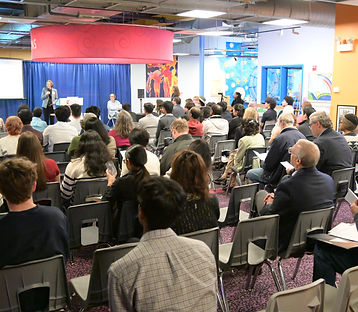
Northern Illinois Science Educators (NISE) Annual Conference
Executive Director, Cathy Clarkin, and Youth Program Specialist, Julie Wachowski, were privileged to present a program to teachers from around our region about how we engage students in authentic, real-world learning about climate change and environmental protection. In addition to sharing about the BLAST program, they provided ideas for activities to connect climate change to the people, places, and things that students care about.
Authentic Problem Solving: Sustainability,
Environment, Climate Change Presentation

Reliable Climate Change Information
With misinformation rampant, climate change politicized, and government information becoming less trustworthy, it can be hard for students (and teachers) to know how to identify reliable sources of information. Here are some sources of climate change and climate solutions information that we trust.
Websites
Subject to Climate: Free teacher resources on climate change for all K-12 subjects.
Illinois Climate Education Hub: A hub of trusted resources, vetted by scientists and reviewed by teachers, to help Illinois educators bring climate and sustainability literacy to students across the state.
Environmental Education Association of Illinois: EEAI foster sconnections, improves environmental literacy, and amplifies underrepresented voices in the environmental education sphere.
Climate.us: For more than a decade, NOAA’s Climate.gov website has been the U.S. government’s premier platform for climate information for the public. In the first half of 2025, NOAA terminated Climate.gov’s full-time federal and contractor staff, shutting down the site's daily operations.
Now, former members of the Climate.gov team have joined together with nonprofit partners to launch Climate.us: a successor to Climate.gov outside the federal domain, where we can safeguard climate information from political interference.
Climate Central: Their mission is to communicate climate change science, effects, and solutions to the public and decision-makers. Among their values are policy neutrality and scientific integrity. Their resources include The Climate Shift Index (CSI), a daily temperature attribution system, applying the latest peer-reviewed methodology to map the influence of climate change on temperatures across the globe, on both land and in oceans.
Climate Central has a ready-made presentation Key Facts on Climate Change. It's a great resource to present to students, or extract what you need for your own presentation!
RMI is a nonprofit researching the global energy system and the clean energy transition. They provide in-depth analysis of a wide range of topics, including clean manufacturing, grid-scale battery recycling, building electrification, renewable energy markets, and more.
Yale Program on Climate Change Communication: Their education program includes, materials for teachers who are interested in using our resources in their classrooms, such as the Yale Climate Opinion Maps and Yale Climate Connections. These materials were developed based on recommendations from educators across the United States. They aim to immerse students in climate change issues in an accessible, digestible, and interactive way.
Project Drawdown: Project Drawdown is an independent, internationally trusted organization driving meaningful climate action by connecting people like you to science-based climate solutions and strategies. Their Drawdown Explorer tool provides detailed information on the climate solutions that are proven to reduce carbon emissions and Climate Solutions 101 video series provides foundational knowledge.
Climate Mental Health Network provides multiple resources to help students, teachers, aparents, and the community build emotional resilience in a climate of change. Their educator resources page includes a climate emotions toolkit for middle schoolers, high school education plans, and more.
National Environmental Education Foundation provides a Climate Emotions Toolkit, including an educator guide, meditations, and student activities.
Climate Program Portal: Federal government websites are no longer being kept up-to-date with the latest data and research. In some cases, evidence-based information is being replaced with blatantly partisan political opinion. This portal has a list of websites that have archived valuable government data and resources, made available to the public.
Datasets for Your Students to Explore and Analyze
Climate Interactive EnRoads: En-ROADS is an online simulator that provides policymakers, educators, businesses, the media, and the public with the ability to test and explore cross-sector climate solutions.
Climate Vulnerability Index: A mapping tool to understand the climate vulnerabilities of different communities in the United States.
Climate Trace: Looking for a trove of data for your students to dig into and analyze? Look no further than Climate Trace. Their mission: We make meaningful climate action faster and easier by harnessing technology to track greenhouse gas (GHG) emissions and other pollutants with unprecedented detail and speed, delivering information that is relevant to all parties working to achieve net-zero global emissions.
Interactive Air Quality Mapping by Purple Air: Real-time data on PM2.5, crowd sourced. (Accelerate Climate Solutions' student-led AirAware project included!)
Costal Risk Screening and Mapping Tools: Search or navigate interactive tools above to see maps of areas below different amounts of sea level rise and flooding, down to neighborhood scale, matched with area timelines of risk. The tool also provides statistics of population, homes and land affected by city, county and state, plus links to factsheets, data downloads, action plans, embeddable widgets, and more. From Climate Central.
Measure of America: From the Social Science Research Council, Measure of America provides easy-to-use yet methodologically sound tools for understanding the distribution of well-being and opportunity in America and stimulating fact-based dialogue about issues we all care about: health, education, and living standards.
Scientific Journals
Peer-reviewed articles are often the most reliable sources of information. Groundbreaking discoveries or innovations reported in journal articles often make the news. News articles are sometimes more accessible and easier to understand the original.
Oxford Academic list of Climate Journals
Videos
Crash Course Climate & Engery is a well-research YouTube program giving students the basics of climate science and addressing climate impacts, solutions, and action.
Undecided with Matt Ferrell reviews the latest clean energy technology.
Ted.com climate change playlist.
PBS Weathered on YouTube had many great episodes on the science of climate change.
Books
All We Can Save, edited by Ayana Elizabeth Johnson and Katherine Wilkinson
Killed by a Traffic Engineer by Wes Marshall
World Without End: An Illustrated Guide to the Climate Crisis by Jean-Marc Jancovici, Christophe Blain
The Sixth Extinction by Elizabeth Kolbert
No Miracles Needed by Mark Jacobsen
An Immense World by Ed Yong
What if We Get It Right by Ayana Elizabeth Johnson
Saving Us by Katharine Hayhoe
Podcasts
Volts with David Roberts covers all of the latest technology and policy solutions to climate change.
Drilled with Amy Westervelt addresses the roots of climate misinformation.
Climate One addresses all aspects of the challenge of climate disruption.
Outrage and Optimism with former UN climate chief Christiana Figueres and her co-hosts, this podcast addresses international cooperation on climate mitigation and adaptation.
Shift Key with Robinson Meyer and Jesse Jenkins digs into how the impacts of climate change and the efforts to address it are transforming the economy, politics, and society.
Climate Reporting
Climate Leaders/Scientists to Follow
Katharine Hayhoe, author of Saving Us, Podcast Talking Climate, LinkedIn
Jesse Jenkins, energy transition expert, LinkedIn
Ayana Elizabeth Johnson, oceanographer, author, climate communicator, Webpage, LinkedIn
Bill McKibben, journalist, author, activist, grandfather of the climate movement, Webpage
Leah Stokes, climate policy professor, author, Webpage, LinkedIn
Michael Mann, climate scientist, author, Webpage, LinkedIn
Marco Te Brömmelstroet, professor of Urban Mobility Futures, author of Movement: how to take back our streets and transform our lives, LinkedIn
Youth Climate Organizations
Pacific Islands Students Fighting Climate Change
Future Council (Teacher resources)
Places to Visit Locally